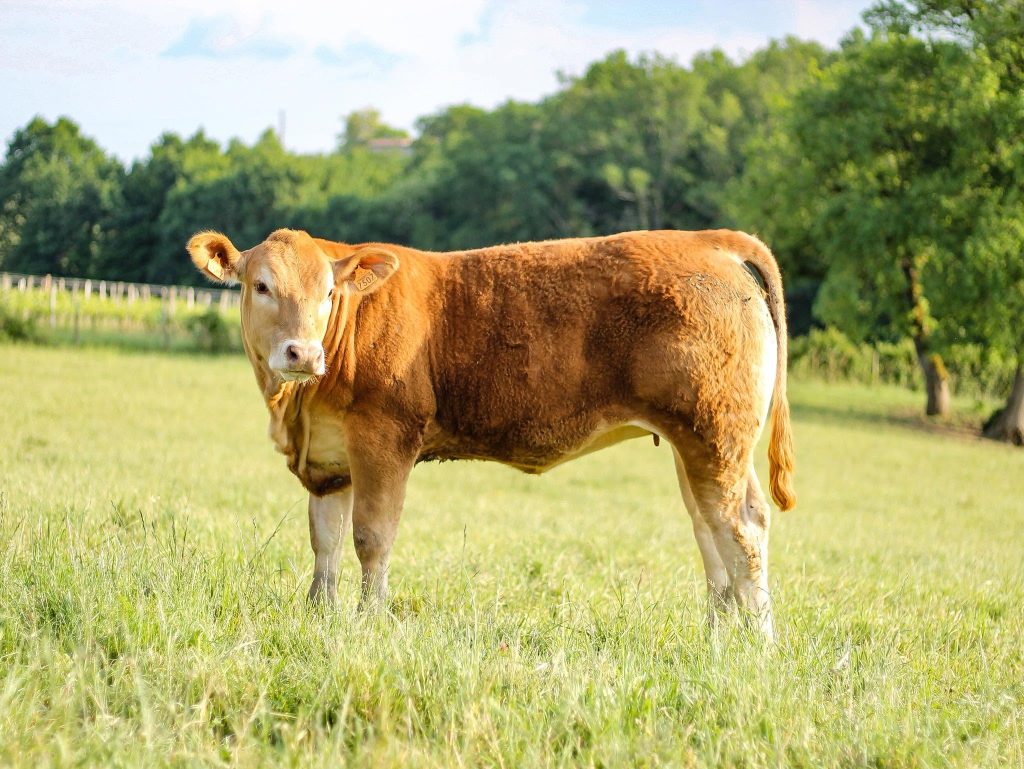
Only a few years ago, a polled Limousin in a field was something of a surprise. Today, at Château Pique-Sègue, it has become the norm among our young stock. Of the 85 animals in the herd that have been genetically tested, 83 carry the polled gene, and 22 carry two copies of it. That’s no accident: it’s the result of a breeding choice held to, generation after generation.
In this article, we explain why we made that choice, how polled genetics work, and how we built them without sacrificing anything that makes a good Limousin.
Horns are first and foremost a safety issue. Between animals, a horned cow can injure herd mates at the feed barrier or in a handling race. And for the farmer, who handles the cattle every day, the risk is never zero.
The usual answer is disbudding calves. But it’s a stressful procedure for the animal, it takes time and it requires good practice. A calf born without horns is simply one procedure less, for the calf and for you.
There is also a commercial reason. More and more buyers of breeding stock, in France and abroad, are asking for polled genetics. A bull that passes on the trait carries real added value.
The polled trait is dominant: a single copy of the gene is enough for an animal to be born without horns. That’s why we talk about genotype, and there are three:
A concrete example. A P/+ cow bred to a horned bull will produce, on average, one polled calf in two. With a P/P bull, every calf will be polled. And two P/+ parents will produce about three polled calves out of four, one in four of them homozygous.
That’s why genetic testing matters so much. To the eye, a P/P cow and a P/+ cow look the same: neither has horns. Only genotyping tells you what she will pass on. Every page in our catalogue shows the genotype when it is known.
Breeding for polled cattle didn’t happen overnight. It was built over several generations, by choosing bulls that carry the gene and keeping the females that pass it on.
The figures speak for themselves. Of the 85 genotyped animals in the herd, 83 are polled, and 22 are homozygous P/P, females and males alike. The trend is gathering pace among the young stock: of the 47 calves born in 2025, 30 are already confirmed polled by testing.
Some families show the path clearly. Nazareth, born in 2017, is homozygous P/P. She produced Ursuline, who necessarily carries the gene, then Valentine, also P/P. The same goes for Oaxaca M4, a homozygous cow: all four of her daughters in the herd carry the trait. Once a P/P cow enters a line, the polled trait is there to stay.
The trap with such a visible trait would be to sacrifice everything else to it. Choosing a bull only because he is polled means risking a loss of growth, milk or calving ease. That’s not our approach.
Polled is one criterion among others. It comes on top of the qualities that make a good Limousin: calving ease, milking ability, muscular and skeletal development, maternal value. Our animals are evaluated with the French IBOVAL genetic indexes, where 100 is the breed average, and every mating is planned on the whole profile.
The results show it. Vanuatu, homozygous P/P, scores 107 for weaning and 106 for calving ease. Alpine, also P/P, scores 114 for weaning and 110 for maternal value. Valseuse combines the P/P genotype with 109 for calving ease and 108 for maternal value. Polled and high-performing: exactly what we’re after.
In a herd, progress usually moves fastest through the bull. A P/P sire passes the trait on to all of his calves, on every cow he serves.
Several young bulls born on the farm are homozygous: Arès M4, Arthur M4, Aristot M4, Acolyte M4, Ace M4 and Absurde M4. Ace M4, for instance, combines the P/P genotype with outstanding growth, at 369 kg at 210 days. For a breeder looking to move a herd to polled, these are particularly interesting profiles.
The farm also relies on polled bulls recognised for their indexes, such as Trésor, the most muscled bull in the herd, Trèfle, who combines muscle and maternal qualities, and Viking, already TABS certified.
If you want to introduce or strengthen the polled trait in your herd, there are two routes.
The fastest is a P/P bull: from the very first generation, all your calves are born polled, even out of horned cows. The more gradual route is buying P/+ or P/P females, which will bring the gene into your maternal lines.
Either way, look at the genotype, of course, but also at the full set of indexes. A polled animal that calves badly or lacks milk won’t save you any time.
All our breeding stock pages show the polled genotype, the IBOVAL indexes and the full pedigree. They are reserved for our breeders’ area. Register to browse the catalogue, or contact us to talk it through.

