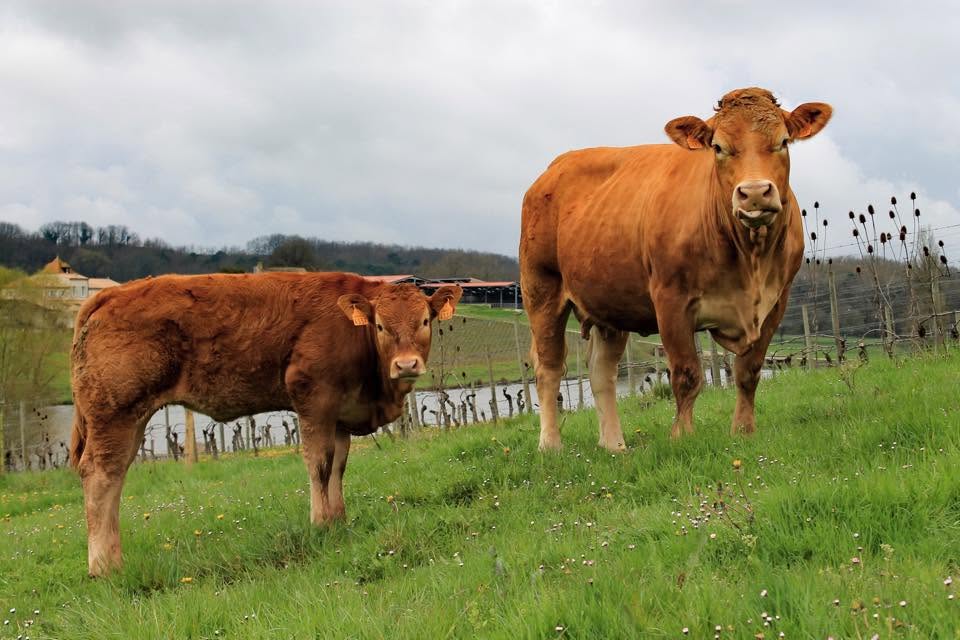
In a Limousin herd, the bull gets the attention. But it’s the cows that build a herd, generation after generation. At Château Pique-Sègue, some families can now be followed over five generations. Here is their story.
It all starts with Etane, a Reproductrice Reconnue (recognised breeding cow). Her daughter Joconde, born in 2014, became one of the herd’s benchmarks: a Reproductrice Recommandée, with 113 for weaning and 109 for maternal value.
Joconde has given the herd six daughters, by six different bulls: Niagara, Tigra, Ucocotte, Vadrouille, Amulette and Berthe, the last born in September 2026, when her dam was nearly 12. The first five all have above-average indexes: Tigra scores 116 for weaning, Ucocotte 115, Vadrouille 118 for muscular development. Berthe, the youngest, is still waiting for hers.
And the line goes on. Niagara produced Tatoo, who produced Bastia and Alto M4. Etane, Joconde, Niagara, Tatoo, Bastia: five generations of the same family on the farm, with above-average indexes at every step.
Hortense was born in 2012. She produced Oiselle, then Vanille at over 11, and Banane in April 2026, at thirteen and a half. Few cows last that long. For a breeder, it’s a trait that appears in no index, yet matters enormously: a cow that lasts is a profitable cow.
She isn’t the only one. Ines calved at nearly 13, Jessie and Jonquille at 12, Joyeuse at nearly 12. These foundation cows are the backbone of the herd.
Not every family starts from the same level. Vero’s line shows what selection can achieve. Vero scored 74 for maternal value. Her daughter Laponie, by Fernand, climbed back to 93. Her granddaughter Pantera M4 reached 101. And the line carries on with Uganda, then Balkan M4.
The same goes for Levrette, a consistent cow at 94 for maternal value. Her daughter Sahara rose to 105. And Valence, Sahara’s daughter, now scores 113, the best maternal value in the entire herd.
Buying a heifer from a family followed over several generations reduces uncertainty. You know how the dams calved, how they raised their calves, how long they lasted. That information completes the indexes, which remain estimates, especially in young animals. To read them well, see our guide to IBOVAL indexes.
These families are also what embryo transfer in the Limousin breed relies on: multiplying the best mothers is the whole point of the technique. And if you wonder how this breeder’s patience connects to the rest of the estate, read our article on the vineyard and the herd.
The pages of all these cows, with their full pedigrees, are in our breeders’ area. For the overall breeding strategy, see our article on polled Limousin genetics.

